The $500 credit option ended
Before this date, a buyer who did not get the statement “shall receive upon the transfer of title a credit of five hundred dollars.” Flood questions were added. Chapter 484 of the Laws of 2023.
The seller of a one- to four-family home must complete and sign the State’s Property Condition Disclosure Statement and deliver it to the buyer or the buyer’s agent before the buyer signs a binding contract.
Since March 20, 2024, the law no longer offers a $500 credit instead. Co-op apartments and condo units are not covered, and 14 kinds of transfers are exempt.
Prepared by Joseph DeVito, a New York Licensed Associate Real Estate Broker and attorney, writing as a broker, not as your lawyer. Legal sources reviewed October 11, 2026.
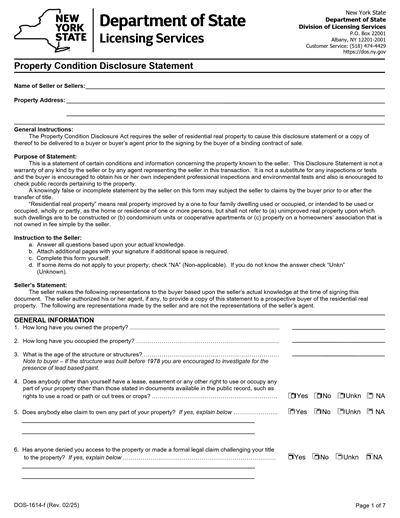
Yes, for most sales of a one- to four-family home. New York Real Property Law §462 requires the seller to complete and sign a Property Condition Disclosure Statement and deliver it to the buyer or the buyer's agent "prior to the signing by the buyer of a binding contract of sale." A copy signed by both seller and buyer is attached to the contract. The law does not cover condominium units, cooperative apartments, land not yet built on, or homeowners'-association property the seller does not own outright, and 14 kinds of transfers are exempt.
Answer from actual knowledge. “Unkn” is allowed where the answer really is unknown.
Give it to the buyer or the buyer’s agent before the buyer signs a binding contract.
If it becomes materially inaccurate, deliver a revision as soon as practicable, until closing or the buyer moves in.
Selling a co-op or condo? New York’s Property Condition Disclosure Act does not apply to condominium units or cooperative apartments. Both are expressly excluded under Real Property Law §461(5), so sellers of these properties are not required to provide the Property Condition Disclosure Statement. Other disclosure obligations under applicable law may still apply. More: co-ops and condos.
On March 20, 2024, Chapter 484 of the Laws of 2023 took effect. It removed the rule that gave a buyer a $500 credit at closing when the seller did not deliver the statement, and it added questions about the property's flood zone, flood insurance and flood history. On July 1, 2025, Chapter 353 of the Laws of 2024 took effect: the Department of State's updated form, DOS-1614-f (Rev. 02/25), became required, with a new note under the septic and cesspool question pointing to the State Department of Health's Septic System Operation and Maintenance pamphlet.
Before this date, a buyer who did not get the statement “shall receive upon the transfer of title a credit of five hundred dollars.” Flood questions were added. Chapter 484 of the Laws of 2023.
DOS-1614-f (Rev. 02/25), with a new note pointing to state guidance on septic systems and cesspools. Chapter 353 of the Laws of 2024.
Question 36 asks the seller to identify the property’s sewage system (public sewer, private sewer, septic or cesspool) and, for a septic system or cesspool, to give from actual knowledge its age, when it was last pumped, how often it is pumped, and any known material defects. Those questions were already on the form. The 2025 change added a note directing readers to the New York State Department of Health’s Septic System Operation and Maintenance pamphlet, which explains how septic systems work, recommended maintenance and potential problems.
What this means for sellers: use the current form and answer the sewage-system questions accurately from what you actually know. The 2025 change did not, by itself, require a new septic inspection or certification, and the disclosure law does not require sellers to investigate the property to complete the statement. Local rules on septic permits, repairs or replacements may also apply.
A separate law, General Business Law §396-s, requires builders of newly constructed homes with a septic system to give the buyer that pamphlet at closing. It is a new-construction rule.
Official resources: current disclosure form · Department of Health: Septic System Operation and Maintenance · Real Property Law §462
It is the Property Condition Disclosure Statement, form DOS-1614-f, published by the New York Department of State; the version required beginning July 1, 2025 is Rev. 02/25. Its wording is set out in Real Property Law §462. Its 56 questions cover general information, environmental and flood conditions, the structure, mechanical systems, and the school district. Most are answered Yes, No, Unkn (unknown) or NA, but several ask for written details, such as how long the seller has owned the home, the age of the house and roof, the water, sewage and electric service, and the school district, and many "yes" answers must be explained in writing. A different Department of State form, the New York State Disclosure Form for Buyer and Seller, explains real estate agency relationships, not the home's condition.
Flooding questions are especially relevant on Long Island and in Queens. Since March 20, 2024, New York’s Property Condition Disclosure Statement asks sellers about a home’s flood history: whether the property is in a FEMA flood zone, whether it carries flood insurance, whether flood-insurance claims were filed, and whether federal flood assistance was received. These are questions 10–17. Questions 38–39 also ask about flooding, drainage or grading problems that left standing water on the property, and about water getting into the house from seepage or a natural flood event. See our flooding guide →
Not every question can be answered by checking Yes, No, Unkn or NA. Some ask for specific information, and others call for an explanation or a supporting document.
Other questions may also need a written explanation, depending on the seller’s answers.
When a seller answers Yes to these questions, the form directs the seller to attach:
If the seller doesn’t know an answer: the statement is completed from the seller’s actual knowledge, and the form allows “Unkn” when an answer is genuinely unknown. Real Property Law §462(3) does not require new inspections, investigations or public-record searches just to complete it. If the form calls for a report the seller cannot locate, raise it with the attorney handling the sale rather than misstating whether it exists.
The statement “is not a warranty of any kind by the seller,” and the buyer is encouraged to get independent inspections. View, print or download the official form →
Real Property Law §463 lists 14 kinds of transfers that do not require the statement. They include transfers under a court order; foreclosure-related transfers and certain transfers to or by a mortgage lender; transfers by a sheriff or in a partition action; transfers by a fiduciary administering an estate, guardianship, conservatorship or trust; transfers between co-owners, to a spouse or a direct-line relative, or between spouses under a divorce, annulment or separation; transfers to or from a government; and newly built homes that have never been lived in. Selling "as is" is not an exemption.
No. Exemption 7 covers a transfer by a fiduciary, such as an executor or administrator, in the course of administering the estate. The list does not include a sale by heirs who already own the home. The estate’s attorney confirms which applies.
The seller. The form tells the seller to "complete this form yourself" and to answer from actual knowledge, and its answers are the seller's representations, not the agent's. The seller does not have to inspect the property or check public records, and may answer "Unkn." Under §466, the listing agent must inform the seller of these obligations in time, and the buyer's agent must inform the buyer of the buyer's rights and obligations before the buyer signs a contract.
As your listing agents we explain these obligations at the start. Your attorney advises on the answers.
Or call (516) 770-3782No. Until March 20, 2024, Real Property Law §465 provided that if the seller did not deliver the statement before the buyer signed, the buyer "shall receive upon the transfer of title a credit of five hundred dollars." Chapter 484 of the Laws of 2023 removed that provision, so the law no longer offers a credit in place of the statement. Section 465 now says the disclosure law does not limit "any existing legal cause of action or remedy."
Not automatically. Real Property Law §463 exempts a transfer by a fiduciary, such as an executor or administrator, in the course of administering a deceased person's estate. The exemption list does not include a sale by heirs who already own the home. Whether a particular estate sale qualifies is a question for the estate's attorney.
Related: what sellers pay at closing.
Before the buyer signs a binding contract of sale. The law defines that as a purchase contract or offer that, once the seller signs it and any contingencies are satisfied, would require the buyer to accept title (§461). The statement can go to the buyer or to the buyer's agent.
Not under this law. Real Property Law §461(5) expressly excludes "condominium units or cooperative apartments" from "residential real property," so sellers of these properties are not required to provide the Property Condition Disclosure Statement. Other disclosure obligations under applicable law may still apply; ask the attorney handling your sale.
Not under the Property Condition Disclosure Act. For the sale of an existing home, septic and cesspool information goes in Question 36 of the Property Condition Disclosure Statement, which asks for the type of sewage system and, for a septic system or cesspool, its age, when it was last pumped, how often it is pumped and any known material defects. The form also refers sellers to the State Department of Health's Septic System Operation and Maintenance pamphlet. A separate rule, General Business Law §396-s, requires builders of newly constructed homes with a septic system to give buyers that pamphlet. Local rules on septic permits, repairs or replacements may also apply.
If the seller learns something that makes the statement materially inaccurate, the seller must deliver a revised statement to the buyer "as soon as practicable" (§464). The law sets no fixed number of days. The duty ends at closing (the transfer of title) or when the buyer moves in, whichever comes first; after that, no revised statement is required.
No. The law does not require a seller to investigate or inspect the property or to check public records (§462). The answers are based on what the seller actually knows, and "Unkn" is an allowed answer. The form itself says it is not a substitute for inspections and encourages the buyer to get independent inspections and tests.
It depends on the facts; not every omission makes a seller liable. Under §465, a seller who provides the statement, or who provides or fails to provide a revised one, is liable under the disclosure law only for a "willful failure" to meet its requirements, and then for the buyer's actual damages plus any other remedy the law allows. The disclosure law also does not limit any other legal claim a buyer may have, and the form warns that a "knowingly false or incomplete statement" may subject the seller to claims by the buyer before or after closing. Whether a claim exists in a particular sale is a question for the attorney handling it.
Not under the statute. An "as is" sale is not one of the 14 exemptions in §463. Section 462 separately says the buyer and seller may still make agreements about the property's condition, including a sale "as is."
Thinking about selling? Talk to The DeVito Team about your selling plan →
Every source was read on October 11, 2026. What a seller pays at closing is on seller closing costs in New York.
Joseph DeVito is a New York Licensed Associate Real Estate Broker and a New York attorney. He does not act as both broker and attorney on the same transaction: here he acts as a real estate broker only, and he is not your attorney. Real estate services provided through Keller Williams Realty Greater Nassau are not legal representation. Everything on this site is general information for educational purposes only. It is not legal advice, it creates no attorney-client relationship, and it should not be relied on as legal advice — for advice about your own situation, consult your own attorney.
This page is general information about New York law, not legal advice for your sale. What you must disclose, and how, depends on the property and the contract, so confirm it with the attorney handling your sale.

The DeVito Team of Keller Williams Realty Greater Nassau
Joseph DeVito, NY Licensed Associate Real Estate Broker
400 Garden City Plaza Ste 438, Garden City, NY 11530 · (516) 770-3782